



Whether you are a weekend hobbyist capturing sunsets or a seasoned professional shooting commercial campaigns, having the right gear can mean the difference between a forgettable snapshot and a breathtaking image. The best camera accessories do not just add convenience. They expand what is creatively possible, protect your investment, and help you capture fleeting moments with confidence.
In this guide, we have rounded up 7 must-have camera accessories for every photographer, from practical essentials like memory cards to advanced tools like the MIOPS Smart+ camera trigger.
1. MEMORY CARDS FOR CAMERAS
| Your camera is only as fast as the card inside it. Memory cards are perhaps the most underestimated accessory, yet they directly impact your shooting speed, file reliability, and storage capacity. |
Types of Memory Cards
- SD Cards (SDHC / SDXC): The most widely used format. Look for UHS-I or UHS-II speed ratings for fast write performance.
- CFexpress Cards: The modern choice for high-end Sony, Canon, and Nikon mirrorless cameras. Essential for 4K/8K video and burst shooting.
- MicroSD Cards: Common in action cameras and drones. Compact but typically slower than full-size SD.
- CompactFlash (CF): Still found in some professional DSLRs, being phased out in favor of CFexpress.
Recommended Brands
- Sony Tough Series: Built to withstand drops, bends, and water exposure.
- SanDisk Extreme Pro: Excellent read/write speeds at a competitive price.
- Lexar Professional: Strong balance of speed and value across camera brands.
| Pro tip: Always carry at least two memory cards and format them in-camera before each shoot. |

2. CAMERA LENS FILTERS
| Camera lens filters physically modify the light entering your lens before it reaches the sensor. Unlike digital effects, they create optical results that editing software cannot fully replicate. |
Camera lens filters attach to the front of your lens and fundamentally alter how light enters your camera. Every serious photographer should carry at least a few in their kit.
UV Filters
In the digital era, UV filters serve primarily as lens protection against dust, moisture, and scratches. Far cheaper to replace than a lens. Brands like Hoya and B+W offer multi-coated UV filters with no perceptible image quality loss.
Polarizing Filters
A circular polarizing filter (CPL) reduces glare on water and glass, deepens blue skies, and boosts color saturation without any post-processing. It captures the world as the eye sees it, which no amount of editing can fully replicate.
ND Filters
Neutral Density filters reduce light entering your lens without affecting color. They allow wide apertures in bright daylight, silky long exposures, and cinematic video frame rates. Variable ND filters offer adjustable density in a single filter.

3. ACCESSORIES FOR SONY, CANON, NIKON AND OTHER POPULAR BRANDS
| Most camera accessories are universal. However, remote triggers vary by brand. Choosing accessories with broad compatibility, particularly camera triggers that work across brands via interchangeable cables, saves money and protects your investment as you upgrade bodies over time. |
Prioritizing universal compatibility gives you the freedom to upgrade your camera body without replacing your accessories. This matters most when it comes to camera triggers, where brand-specific connections are the norm.
How Trigger Compatibility Works by Brand
- Sony Alpha (A7, A9, ZV Series): Connect via the Multi Terminal port. The MIOPS Smart+ supports Sony via the appropriate cable with no proprietary restrictions.
- Canon EOS R and DSLR: Connect via N3 or 3.5mm terminal depending on the model. Full MIOPS Smart+ compatibility across the range.
- Nikon Z and D Series: Connect via MC-DC2 or 10-pin connector. Both mirrorless and DSLR bodies are fully supported.
- Fujifilm, Olympus, Panasonic: Each has its own port standard. The MIOPS Smart+ supports all of them through interchangeable trigger cables. One trigger. Every brand.
When evaluating any accessory, look for explicit compatibility lists that cover your current camera and likely future upgrades. Open standards like universal tripod mounts (1/4-20 thread), standard filter threads, and multi-brand trigger cables will serve you across many camera generations.
4. CAMERA BAGS AND CASES
Your camera gear represents a significant investment. The right bag does not just protect it. It organizes your kit so you can access exactly what you need, exactly when you need it.
Types of Camera Bags
- Backpacks: Ideal for landscape and travel photographers carrying a lot of gear. Look for padded dividers and weather resistance.
- Shoulder and Sling Bags: Quick one-handed access. Perfect for street photographers who need to move fast.
- Rolling Cases: Best for studio work and airline travel. Hardshell options offer maximum protection.
- Holster Cases: Single body plus lens. Lightweight for day hikes and casual shoots.
- Waterproof Cases: Essential for shooting in wet or extreme environments.
Key Features to Look For
- Weatherproofing to protect against sudden showers.
- Customizable padding so the interior fits your exact gear layout.
- Anti-theft features like lockable zippers and slash-resistant materials.
- Carry-on compliance if you travel frequently by air.

5. MIOPS CAMERA TRIGGER
| A camera trigger fires your shutter in response to an external signal such as sound, motion, or a laser beam. It captures moments that are too fast for manual reaction, including lightning strikes, water droplet impacts, and wildlife in motion. |
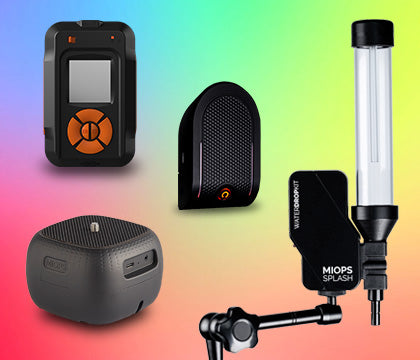
Of all the accessories on this list, a smart camera trigger most dramatically expands your creative possibilities. The MIOPS Smart+ is a multi-function trigger that connects to your camera and smartphone, firing your shutter based on a wide range of inputs. One device replaces a drawer full of specialty triggers.
MIOPS Smart+ Triggering Modes
- Sound Trigger: Fires when it detects a sound above a set threshold. Perfect for balloon pops, glass shattering, and concert moments.
- Laser Trigger: An invisible beam fires the camera the instant a subject breaks it. Great for birds in flight and sprinting athletes.
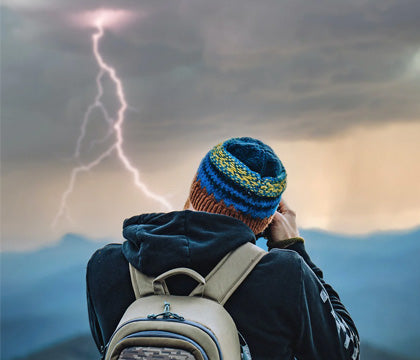
- Lightning Trigger: Detects the electromagnetic signature of a strike and fires fast enough to capture it reliably on the first attempt.
- Time-Lapse Mode: Program custom intervals from the MIOPS app. Blooming flowers, city sunrises, star trails.
- HDR Mode: Automatically captures multiple exposures for seamless HDR compositing.
- Bulb Ramping: Smoothly adjusts exposure throughout a timelapse as light changes. Ideal for day-to-night sequences.
Why It Works Across Every Brand
- Compatible with Canon, Nikon, Sony, Fujifilm, and more via interchangeable cables. No proprietary lock-in.
- The MIOPS mobile app (iOS and Android) handles all configuration without complicated camera menus.
- Reacts in milliseconds, capturing moments impossible to catch manually.
- Pocket-sized. Adds virtually no bulk to your kit.
6. SPARE BATTERIES
| Most professional photographers carry at least two to three fully charged batteries for any serious shoot. Cold weather and heavy video recording drain batteries far faster than normal conditions. |
A single battery may last only 300 to 500 shots under normal conditions, and far fewer in winter or when shooting video. Spare batteries are one of the cheapest and most critical accessories you can own.
Recommended Battery Types
- OEM Batteries (Canon LP-E6NH, Nikon EN-EL15c, Sony NP-FZ100): Gold standard for reliability. They communicate fully with your camera battery management system.
- Third-Party (Wasabi Power, Patona, Newell): Significantly cheaper and reliable enough as backups for most uses.
- USB-C Charging: Many modern cameras from Sony, Fujifilm, and Canon support in-body USB-C charging. A power bank becomes a mid-shoot power source.
| Always charge batteries the night before a shoot and store them at room temperature to maximize lifespan. |

7. TRIPODS AND STABILIZERS
| In-body stabilization reduces hand tremor but cannot eliminate all movement during long exposures. A tripod is the only way to guarantee a completely stable platform for sharp long-exposure photography. |
A quality tripod eliminates camera shake entirely, enabling shots that simply are not possible handheld, particularly in low light, with telephoto lenses, or when shooting video.
Types of Tripods
- Travel Tripods: Lightweight carbon fiber or aluminum that folds small. Joby, MeFoto, and Peak Design have redefined portability.
- Studio Tripods: Heavy-duty for maximum stability in controlled environments.
- Gorillapods: Flexible mini-tripods that wrap around branches and railings. Great for vlogging and macro work.
- Video Fluid Head Tripods: The fluid head dampens movement for smooth, professional-looking camera motion.
- Monopods: Single-legged support without the footprint of a full tripod. Popular with sports photographers.
How to Choose the Right One
- Weight capacity must exceed your heaviest camera and lens combination.
- Maximum height should reach eye level without extending the center column.
- Carbon fiber is lighter and absorbs vibration better. Aluminum is more affordable.
- Ball heads for stills. Fluid heads for smooth video movement.
THE RIGHT ACCESSORIES CHANGE EVERYTHINGThe best camera accessories are multipliers. A smart trigger like the MIOPS Smart+ opens the door to creative photography that simply is not possible any other way. |
Frequently Asked Questions