



The Short Answer
For storm photography, any camera with full manual control and RAW capture works. What matters more than the body is your lens (wide angle, 16 to 35mm equivalent), your tripod, and a lightning trigger. A full-frame mirrorless or DSLR from the past five years is more than capable. Start with what you have, and spend on the supporting gear before you even think about upgrading the body.
Gear questions are usually where people start when they get serious about storm photography. And the advice they find is nearly always the same: full-frame camera, wide lens, solid tripod. That's correct. But it leaves out all the reasoning, and it doesn't help you figure out what to prioritize if you're not working with an unlimited budget.
This guide goes through every piece of equipment in a storm kit, what it actually does, and where the real differences in performance show up. Some of those differences are not where you'd expect.
1. The Camera Body
What Actually Matters
Manual mode with full exposure control. Every camera sold in the past decade has this. It's not a differentiator.
RAW file capture. Lightning creates extreme dynamic range. The bolt can be eight to ten stops brighter than the surrounding sky. RAW preserves the full tonal range; JPEG compresses and throws data away at capture. Almost every camera made in the past ten years shoots RAW.
Weather sealing. This matters more for storm photography than for almost any other discipline. You're shooting in rain, dust, and occasionally hail. A sealed body handles moderate rain without damage. An unsealed body needs a rain sleeve, which is a cheap and perfectly workable solution.
Sensor size and low-light performance. Full-frame sensors produce cleaner files at higher ISOs than APS-C sensors, which produce cleaner files than Micro Four Thirds. For night lightning photography, where you're typically working between ISO 400 and 800, full frame gives you a real advantage. The difference is meaningful, but it's not disqualifying for crop-sensor shooters. Good noise reduction in post handles most of it.
What Doesn't Matter Much
Megapixel count is the big one. A 24MP file is more than sufficient for any print size you're likely to make. 45MP and 60MP sensors exist and produce stunning files, but they also demand more storage, more processing power, and more expensive memory cards. There's no practical benefit for lightning photography beyond 24 to 30MP.
Autofocus speed is irrelevant. You're shooting at manual focus set to infinity. The camera's AF system, however sophisticated, plays no role.
In-body image stabilization (IBIS) should actually be turned off when you're on a tripod. On a stable platform it can introduce micro-movement rather than eliminate it. IBIS is a genuine benefit for handheld shooting, which is not what lightning photography is.
Video specs, 4K, log profiles, frame rates. These have no bearing on a stills workflow.
Practical Recommendations
The honest truth is that the gap between a mid-range and a professional body matters less for storm photography than for almost any other genre. Sports photographers need the fastest AF. Wildlife photographers need the deepest buffers. Storm photographers need manual mode and good weather sealing. Those specs appear in cameras at a wide range of price points.
-
If you already own an entry-level or mid-range DSLR or mirrorless, use it. Upgrade your tripod, get a lightning trigger, and put a rain sleeve in your bag before you consider a new body.
-
If you're buying new, any current mirrorless or DSLR with manual mode, RAW capture, and weather sealing from Canon, Nikon, or Sony in the $800 to $1,500 range does what storm photography asks of it. Before you buy, check that your chosen lightning trigger is compatible with the camera's shutter port. The MIOPS compatibility guide covers all current systems.
-
If you're on a crop-sensor body, stay on it. A well-processed APS-C file at ISO 400 is excellent. Full frame is better, but it's not worth abandoning a capable kit to get there.
2. The Lens
This is where your investment actually changes what images are possible. The lens matters more than the body for storm photography, and the reasoning is straightforward.
Why Wide Angle
Lightning is unpredictable. You can't zoom in on a bolt you haven't located yet. A wide field of view gives you the best chance of keeping any bolt within the frame, lets you include meaningful foreground in the composition, and gives the storm the spatial scale that makes it look as enormous as it actually is.
The most useful range is 16 to 24mm on full frame (10 to 16mm on APS-C, 8 to 12mm on Micro Four Thirds). That focal length range is wide enough to capture the full storm structure with a foreground element, but not so wide that a bolt becomes a thin line lost in an overwhelming amount of empty sky.
For situations where you're shooting a shelf cloud or supercell that spans most of the horizon, an ultra-wide in the 12 to 14mm range does things no other focal length can.
Lens Quality: What to Look For
Sharpness at f/8. This is the aperture you'll use most. Most modern lenses from reputable manufacturers are very good at f/8, though corner sharpness varies more than center sharpness. In wide landscape compositions, edge detail matters.
Fast maximum aperture. An f/2.8 lens lets you shoot in darker conditions at lower ISO. In practice, you'll rarely open wider than f/5.6 for storm work, so a fast maximum aperture is more of a reserve than a daily requirement. An f/4 wide zoom handles most situations.
Weather sealing. A sealed lens paired with a sealed body gives you a fully weather-resistant system. An unsealed lens on a sealed body leaves the mount as a potential ingress point. For dedicated storm work, sealed glass is worth the premium.
Lens Recommendations by Budget
|
Tier |
Price |
Recommended Lenses |
|
Budget |
Under $400 |
Canon EF-S 10-18mm f/4.5-5.6 IS STM, Nikon AF-P 10-20mm f/4.5-5.6G, Sony 10-18mm f/4 (APS-C systems) |
|
Mid-Range |
$400-$1,000 |
Tamron 17-28mm f/2.8 (Sony FE), Sigma 14-24mm f/2.8 Art (Canon/Nikon/Sony), Canon RF 14-35mm f/4L |
|
Professional |
$1,000+ |
Sony 12-24mm f/2.8 GM, Canon RF 15-35mm f/2.8L IS, Nikon Z 14-24mm f/2.8 S |
3. The Supporting Kit
This is where storm photographers most often underinvest, and it's usually where the difference between a productive session and a frustrating one actually lives.
Tripod
A carbon fiber tripod from a manufacturer like Gitzo, Benro, or Peak Design offers the best combination of rigidity and low weight. For storm work specifically, rigidity in wind matters. A tripod that wobbles during a fifteen-second exposure introduces blur that ruins the frame, and there's no recovering from it in post.
A few things worth paying attention to: ballhead controls should be accessible with gloves on, because small thumbscrews become genuinely difficult in cold and wet field conditions. And avoid raising the center column. It creates a pendulum effect in gusts that a locked-down leg set wouldn't have. The tripod's practical height should reach eye level without the column extended.
Rain Sleeve
A basic silicone or clear plastic rain sleeve costs between $10 and $20, and it means you can keep shooting through weather that would otherwise force you to stop. Keep one in every bag you own, permanently. Some photographers use more substantial weather shields with zippered lens access for active rain conditions, but a basic sleeve handles the majority of field situations.
ND Filters
A 3 to 6-stop ND filter is useful for storm structure photography during daylight when you want longer exposures for motion blur in clouds or smooth water, even when lightning triggering isn't involved. A variable ND in the $50 to $150 range is a practical single-filter solution.
Batteries and Memory Cards
Storm sessions typically run two to four hours. Battery drain is faster than usual due to cold temperatures, continuous live view, and wireless communication with a trigger. Carry at least two batteries for a single-session kit, and three for extended work.
High-speed memory cards are not necessary for single-shot lightning capture. They matter for burst-mode continuous shooting, which is not the standard lightning photography workflow. A reliable mid-range card is all you need.
The Lightning Trigger
A dedicated lightning trigger is the piece of equipment that most directly affects the quality of your output. The idea behind long-exposure lightning photography (open the shutter, wait for a bolt, hope it falls within the frame during the exposure) is a reasonable approach for night shooting in a target-rich environment. But it relies entirely on probability. During daylight, it fails completely, because ambient light prevents the long exposures that method requires.
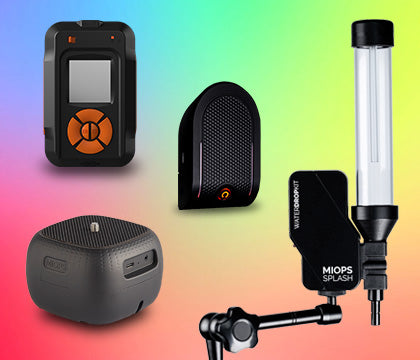
The MIOPS Smart+ solves this. It mounts to the hot shoe, connects to the camera's remote shutter port via cable, and fires the shutter in approximately one millisecond when it detects a qualifying flash. It works in full daylight. It works at night. The sensitivity dial lets you calibrate for storm distance and ambient light conditions. Compatibility covers all major camera systems.
If you're committed to storm photography and you have the core kit sorted (camera, wide lens, tripod), a trigger like the Smart+ is the most impactful upgrade you can make. It changes the outcome of every session by removing timing from the equation entirely.
SEE WHAT THE MIOPS SMART+ CAN DOSound, laser, lightning, timelapse, HDR, and bulb ramping. One device. Compatible with Sony, Canon, Nikon, Fujifilm, and more. |
Frequently Asked Questions
What is the best camera for storm photography?
Any current mirrorless or DSLR with manual mode, RAW capture, and weather sealing does the job. Mid-range bodies from Canon (R7, R8), Nikon (Z6 III, Z50 II), and Sony (A7C II, A6700) all perform at the level storm photography requires. The body is rarely the limiting factor.
What lens is best for lightning photography?
A wide angle in the 16 to 35mm range on full frame (10 to 24mm on APS-C). The wide field of view is what gives you a realistic chance of capturing a bolt without knowing exactly where it will strike.
Do I need a full-frame camera for storm photography?
No. APS-C and Micro Four Thirds sensors produce excellent results, particularly at ISO 100 to 400 which is the typical working range. Full frame gives you cleaner high-ISO files, but at ISO 200 to 400 the practical difference is small.
What settings should I use for lightning photography?
Camera settings are covered in full in our lightning photography settings guide. The short version: manual mode, f/8, ISO 100 to 400, bulb mode at 10 to 20 seconds for night shooting, and a lightning trigger with a fast shutter speed for daylight.
What does 'lightning in camera' mean?
Searches for this phrase usually refer to cameras with built-in lightning detection. No standard camera body includes a dedicated lightning trigger mode. Lightning detection is handled by a separate device connected to the shutter port, such as the MIOPS Smart+. The camera itself needs nothing beyond manual mode and a shutter port.
What storm photography equipment do I actually need?
The core kit: a camera with manual mode and RAW capture, a wide-angle lens (16 to 35mm equivalent), a sturdy tripod, extra batteries, a rain sleeve, and a lightning trigger. Each piece is covered in detail above.
Is a lightning trigger worth it for a beginner?
If you have the core gear covered and you're serious about the discipline, it is arguably the highest-impact upgrade available. It removes timing as a variable from every session. That's the difference between coming home with a handful of bolts captured and coming home with an empty memory card.