




Modern flagship cameras like the Sony A7 IV, Sony A9 III, Canon EOS R5, Canon EOS R6 II, and Nikon Z6 III are extraordinary engineering achievements. They feature AI-assisted autofocus, blazing burst rates, and in some cases pre-capture buffers that begin recording frames before the shutter is ever pressed.
And yet, for certain types of photography, even a $6,000 camera body is not enough. This article explains exactly why external camera triggers like the MIOPS Smart+ remain relevant and practical tools for photographers in 2026, and which shooting scenarios still demand them.
The Core Problem: Reaction Time vs. Event Timing
| 250ms: Average human visual reaction time. Even for trained adults anticipating an event, reacting reliably to unpredictable moments is inherently difficult and inconsistent. |
Modern cameras have addressed this with pre-capture modes that continuously buffer images before the shutter is pressed. When you finally press the button, the camera saves frames from up to one second earlier. The Sony A9 III, for example, can pre-capture up to a full second of footage at up to 120 frames per second, dramatically improving the odds of capturing fast action.
But pre-capture still requires the photographer to anticipate the event and press the shutter within a reasonable window. For genuinely unpredictable events like lightning strikes, balloon pops, breaking glass, or wildlife crossing an unmarked point, no amount of pre-capture fully eliminates the need for a trigger that can detect and react to the event itself.
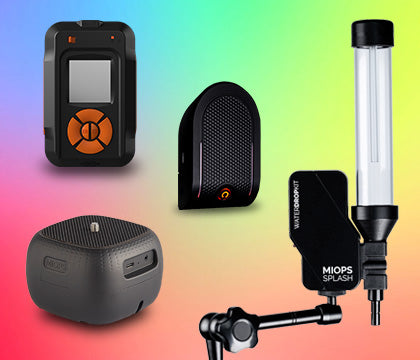
External triggers like the MIOPS Smart+ use environmental sensors to fire the camera or flash the instant an event occurs, bypassing human reaction time entirely.
| Key takeaway: External camera triggers do not compete with pre-capture technology. They solve a fundamentally different problem by responding to the event directly rather than buffering images before a human presses a button. |
High Speed Photography: It Is the Flash, Not the Shutter
One of the most misunderstood principles in high speed photography is this: in many setups, the camera shutter is not what stops the action. The motion is frozen by an extremely short burst of flash.
Here is how a typical high speed photography setup works:
- The room is kept dark.
- The camera shutter is opened on bulb mode.
- An external trigger detects the event, such as a sound or laser interruption.
- The trigger fires the flash.
- The shutter is closed.
Because flash duration can be extremely short (at lower power settings, many speedlights achieve durations of 1/10,000 second or faster), the brief burst of light is the only thing that exposes the sensor. The flash effectively becomes the shutter.
This technique is used routinely in splash photography, projectile photography, breaking glass setups, and scientific imaging. An external trigger is what makes it repeatable and precise.

Holy Grail Timelapse and the Flicker Problem
Most modern cameras include a built-in intervalometer, and for standard timelapse work this is perfectly adequate. However, one of the most technically demanding timelapse scenarios is the transition from day to night or night to day, commonly called the Holy Grail timelapse.
During this transition, light levels change continuously and dramatically. When exposure adjustments happen in large steps, such as changing ISO or shutter speed in fixed increments, the result is visible flicker between frames in the final video.
| External timelapse controllers solve this with a technique called bulb ramping, which adjusts exposure gradually over time in very small increments. This produces smooth, flicker-free transitions across thousands of frames during a sunset or sunrise sequence. Built-in intervalometers on most cameras do not offer this level of fine-grained control. |
Specialized Sensor Modes Cameras Simply Do Not Include
Modern mirrorless cameras contain sophisticated sensors for autofocus and image capture. They do not, however, include the environmental detection sensors needed to automate event-triggered photography. External triggers like the MIOPS Smart+ add these capabilities directly.
Laser Mode
A laser beam acts as a tripwire across a defined point. When an object interrupts the beam, the trigger fires the camera instantly. Commonly used for wildlife photography where animals reliably cross a known path, and for controlled action setups in a studio.
Sound Mode
The trigger detects sudden, sharp sounds like a balloon pop, breaking glass, or a gunshot and immediately fires the camera or flash. Sound detection is one of the most widely used methods in high speed photography because acoustic events are natural and easy to produce on demand.
Lightning Mode
Lightning triggers monitor for rapid changes in ambient brightness caused by a lightning strike, then fire the shutter or flash to capture the event. Manually capturing lightning with consistent results is extremely difficult. A lightning trigger makes it repeatable.
Camera Compatibility: How External Triggers Connect
Most external triggers connect to cameras using standard remote shutter release ports. Depending on the camera brand, the relevant connections include:
- Canon N3 remote port used on mid-range and professional Canon bodies
- Nikon MC-DC2 remote port used on many Nikon bodies
- Nikon 10-pin remote port used on professional Nikon bodies
- Sony Multi-Terminal remote port
- USB-based shutter control on select newer camera models
Because camera manufacturers use different connection standards, trigger systems typically provide model-specific cables or adapters to support various camera bodies. This means a single trigger unit can generally serve photographers who switch systems or use multiple bodies.
Long-Duration Automated Shooting
For timelapse projects and extended wildlife setups that run overnight or across multiple days, external controllers offer one additional practical advantage: they operate independently of the camera body.
Because the trigger runs its own program, it can maintain a shooting schedule without relying on the camera's internal timer. If the camera battery needs to be swapped during a long project, the trigger can resume its programmed sequence as soon as the camera reconnects. This kind of autonomous operation is not available with built-in intervalometers on most camera bodies.
SEE WHAT THE MIOPS SMART+ CAN DOSound, laser, lightning, timelapse, HDR, and bulb ramping. One device. Compatible with Sony, Canon, Nikon, Fujifilm, and more. |
Frequently Asked Questions