



The Short Answer
A frozen splash or pour makes a product feel alive in a way that nothing else in product photography does. The technique for capturing it is less complicated than the results suggest. You do not need a high frame rate camera or any specialist gear beyond a flash and a trigger. A brief burst of flash does the freezing, not the shutter speed, so set your flash to a low power setting for a short pulse, use an aperture around f/8 to f/16 at ISO 100, and set your shutter to your camera's flash sync speed. The real challenge is timing. A splash forms and collapses in milliseconds and your hand is too slow to catch it, which is why professionals use a sound or laser trigger rather than their reflexes. Expect to make a mess, plan for many attempts, and think about compositing from the start. These shots are built through repetition, not luck.
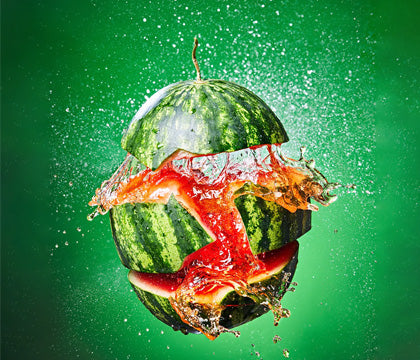
There is a reason every drinks brand, every skincare range, and every culinary product line uses liquid motion in its hero photography. A still glass of orange juice is product information. A glass of orange juice with a wedge of fruit erupting through the surface and a corona of droplets hanging in the air is desire. That one image does in a fraction of a second what paragraphs of copy cannot. And the thing that surprises most people is how achievable it is. You do not need a commercial studio. You need a kitchen table you do not mind getting wet, a flash, a decent tripod, and an understanding of two things: what actually freezes the liquid, and how to be at the right moment when everything happens at once.
Why Liquid Motion Sells
Motion in product photography signals freshness, energy, and quality in a way static shots cannot replicate. This is particularly true for anything consumable or experiential: drinks, food, cosmetics, fragrances, cleaning products. The moment of liquid in motion is associated with the sensory experience of the product itself, which is exactly what a buyer is trying to evaluate when they are shopping online.
From a practical ecommerce perspective, liquid hero shots are among the most shared and saved product images across social platforms. They are versatile across formats, working equally well as product page heroes, social content, advertising creatives, and email headers. A single well-executed splash shot of a product hitting water can serve across every channel in a campaign. The return on the investment in setup time is unusually high compared to other product photography formats.
The other dimension worth considering is differentiation. Most products in liquid-adjacent categories are photographed statically: bottle on white background, maybe a lifestyle context shot. A brand that consistently shows its products in motion stands out visually in a way that communicates energy and premium quality. It reads as a production decision, which reflects on the brand's attitude toward quality generally.
What Actually Freezes a Splash
This is the part that needs to be clearly understood before anything else, because the instinct most people follow is wrong. When you see a frozen splash, you assume a very fast shutter speed was used. In most commercial liquid photography, that is not what happened.
In a controlled lighting setup, the flash pulse is what freezes the liquid. A flash unit set to low power fires a pulse that at 1/16 power or lower can be shorter than 1/20,000 of a second. In a space where the flash provides most or all of the light, that pulse is what captures the image. The shutter only needs to be open long enough for the flash to fire, which means you can shoot at your standard sync speed of around 1/160 to 1/250 and the flash handles the rest.
The practical setup: manual mode, ISO 100, f/8 to f/16 depending on how much depth of field you want and how close your flash is, shutter speed at your sync limit. Aperture and flash power together control brightness. If images are too dark, open the aperture one stop before adjusting flash power, because the aperture also affects depth of field and you want the full splash in focus. Flash should be positioned off to one side, typically at 45 degrees, with a reflector on the opposite side to fill the shadows.
If you are working without flash, a very fast shutter speed of 1/1000 or above with strong continuous lighting can freeze a gentle pour, but it will not freeze an energetic splash with the same sharpness. Flash is significantly more effective for anything chaotic or fast-moving. We cover the full mechanics of why the flash pulse, not the shutter, does the freezing in our high-speed photography guide.
The Three Liquid Shots That Appear in Almost Every Campaign
Most commercial liquid photography is built around one of three setups, and understanding the specific approach for each saves considerable trial and error.
The pour
A stream of liquid filling a glass, or liquid falling from a height into a vessel, reads as immediate and fresh. Pours look simple but they are naturally unpredictable: the stream wobbles, splashes vary from pour to pour, and the surface turbulence is different every time. This is actually useful because it means you have something new to select from in every attempt.
The approach: set up a backlit glass so the liquid itself glows rather than going dark. Use a clean light-colored background. Pour consistently from the same height each time to keep the stream shape predictable. For very dark liquids like red wine or cola, dilute slightly with water so light passes through rather than the liquid rendering as an opaque black mass. Shoot continuously during the pour and review afterward to find the best stream shape and splash.
The drop and splash
Dropping an object into a full glass to generate a symmetrical crown of liquid erupting upward is the classic high-speed product shot. The physics are predictable enough that once your timing is calibrated, you can produce consistent results across many attempts.
Object weight determines splash scale. A cherry or blueberry produces a delicate crown. A citrus wedge, an ice cube, or a heavier fruit produces a more dramatic eruption. Use room temperature liquid because cold glasses fog and cold liquid produces smaller, less photogenic splashes. Fill the glass closer to the rim than you instinctively would, because a fuller glass produces bigger crowns. Put a large tray or plastic sheet under everything and accept that you will be doing this many times before you have a clean hero frame.
The product in liquid: the crown shot
The most ambitious and visually impactful of the three. A can, bottle, or jar plunges into water and a symmetrical ring of liquid rises around it at the moment of impact. This is the shot you see in major drinks advertising and it is the one that produces the most dramatic results when executed well.
The setup requires a tank or deep tray filled with water, clean and uncluttered around the edges because everything in the frame will be visible in the hero shot. The product is dropped into the water from a consistent height and the trigger captures the moment of impact or the crown at its peak. This requires more attempts to dial in than the glass splash because the product itself is the falling object and its orientation, speed, and entry angle all affect the crown shape. Compositing a clean product shot with the best crown from several attempts is standard practice for this setup.
Why Timing Is the Actual Problem
Every photographer who attempts liquid photography for the first time makes the same mistake. They try to press the shutter when they see the splash. It does not work. Not because they are too slow in some correctable way, but because the splash forms and reaches its most photogenic peak in approximately 10 to 50 milliseconds depending on the subject, and human reaction time is around 250 milliseconds at best. By the time you see the crown and begin to press the shutter, the crown has already collapsed.
Professional liquid photographers solve this in two ways.
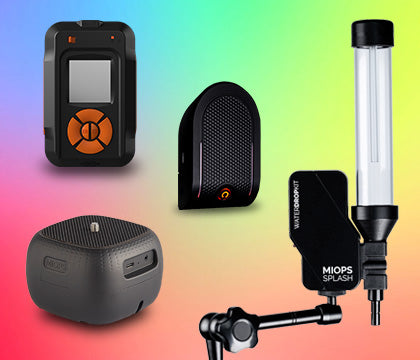
The first is a dedicated trigger. A sound trigger fires the camera or flash the instant the acoustic signature of an impact is detected. The object hits the liquid, the microphone in the trigger hears it, and the flash fires within about one millisecond. With an adjustable delay, you can choose whether to catch the early crown, the peak crown, or the collapse. The MIOPS Smart+ has sound and laser modes with a millisecond-precision delay, which turns what was luck into something repeatable across many attempts. For water-drop work specifically, the MIOPS Splash kit goes further by controlling the drop release itself, so the drop size, fall height, and timing between drops are all standardized, which means the collision is predictable and the crown forms at the same moment in every attempt.
The second method is volume and compositing. Shoot the product on a clean background with no splash. Shoot many splash attempts. Combine the best splash with the cleanest product shot in post. This is industry-standard practice, not a shortcut, and it gives you control over both the product presentation and the splash quality independently. Even with perfect trigger timing, most professional product splash shots are composites.
What About AI Generated Splash Images?
In 2026, AI image generation tools have improved to the point where a beverage splash from a text prompt is not unreasonable to request. For mood board exploration, rough concept visualization, or situations where you need something to fill a placeholder before real photography is scheduled, these tools have become genuinely useful.
For final production images, particularly hero shots and advertising assets, the limitations are real and specific. Liquid physics are hard to simulate convincingly. AI-generated splashes frequently look either too smooth and perfectly symmetrical, which reads as CGI, or wrong in their physics, with droplets in positions that water cannot actually reach from a given impact. Reflective surfaces like cans and glass cause further problems because the model is inventing the environment reflections rather than photographing them, and the inaccuracies are noticeable.
More fundamentally, an AI-generated product splash cannot show your actual product accurately because it is synthesizing from training data rather than photographing the real thing. For a brand where visual accuracy is part of quality signaling, that is a problem the technology has not solved yet.
Frequently Asked Questions
What camera settings should I use for splash product photography?
Manual mode throughout. ISO 100. Aperture of f/8 to f/16 depending on desired depth of field and flash distance. Shutter speed at your camera's sync speed, typically 1/160 to 1/250. Flash at low power for a short pulse. Adjust aperture and flash distance for brightness, not shutter speed. These settings hold for most liquid work.
Do I need special equipment to photograph splashes?
The minimum viable setup is a camera with manual controls, a tripod, a speedlight with manual power settings, and something to trigger the camera at the right moment. A sound trigger or laser trigger removes the timing guesswork. A tray and plastic sheeting manage the mess. Everything else is optional.
Why do my splash photos look soft even when I am using a flash?
Almost always residual ambient light. If the shooting space is not controlled, continuous ambient light exposes during your shutter opening and creates a motion-blurred layer underneath the frozen flash exposure. Make the shooting area as dark as practical, use your flash as the dominant or only light source, and the softness should resolve.
How do professional photographers time splash shots so precisely?
They use triggers, not reflexes. A sound trigger fires the flash the millisecond it hears the impact. A laser trigger fires the instant a falling object crosses the beam. An adjustable delay on the trigger then lets them choose the specific phase of the splash they want to capture. The consistency comes from removing human reaction time from the equation entirely.
How many attempts does it take to get a good splash shot?
More than most people expect, fewer than they fear once the setup is dialed in. The first session with a new subject type is usually about calibration: getting the delay right, adjusting the lighting, understanding how the specific object and liquid interact. Once those variables are fixed, you can produce good frames consistently. Budget a session for calibration and another for production.
Can AI generate liquid product photography for commercial use?
For concepts and placeholders, yes. For production assets and hero shots, the technology is not reliable enough for products where visual accuracy matters. Reflective surfaces, complex liquid physics, and the specific look of your actual product are all areas where AI-generated images produce inaccuracies that are visible to buyers.
Sources
MIOPS Smart+ product page: sound and laser trigger modes, adjustable delay, and compatible camera list: https://www.miops.com/products/smart
MIOPS Splash product page: drop release control, timing specifications, and compatible flash systems: https://www.miops.com/products/splash-pro-pack