


The Short Answer
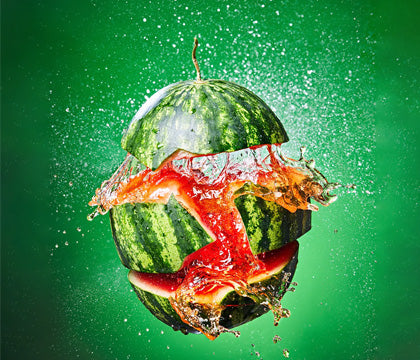
You do not need a fast or expensive camera to freeze a bursting balloon, a milk-drop crown, or a shattering wine glass. Almost any camera with a manual mode is capable of this. The thing most people do not realize is that shutter speed is not what freezes these moments at all. A very brief burst of flash does the freezing, and a trigger does the timing. Set up in a room you can make dark, use a low flash power setting for its short pulse duration, set a narrow aperture around f/11 to f/16 at ISO 100, and let a sound or laser trigger fire at the exact millisecond the action happens. Solve those two things, light and timing, and your existing camera becomes a high-speed capture machine.
We want to address the most common thing we hear before anything else: "I need a faster camera." We understand why people think this. The shots they are trying to make look expensive and technically demanding. The logic seems sound. But it is wrong, and acting on it is how photographers spend a lot of money without solving their actual problem. The camera you already own is almost certainly capable. What is holding you back is a misunderstanding of what actually freezes a fast-moving subject, and once that clicks into place, everything else becomes straightforward.
Why the Camera Is Not the Bottleneck
High-speed photography done in a dark room does not work the way people expect. In normal shooting, you freeze motion by raising your shutter speed. But there is a fundamental constraint that makes this approach fail for the kind of subjects we are talking about: the flash sync speed.
Most cameras sync with flash at around 1/250 of a second. That is the fastest shutter speed you can use with a standard flash before you start getting a dark band across the frame. And 1/250 of a second, while fast, is nowhere near fast enough to freeze a milk drop crown or a bursting balloon sharply. It creates soft, smeared results.
The solution is to stop trying to freeze motion with the shutter and start using the flash itself to do the freezing. Here is why this works. A flash does not provide continuous light. It fires a single, extremely short pulse, and at low power settings that pulse can be shorter than 1/20,000 of a second. Some high-end studio strobes reach 1/80,000 at minimum power. In a room with no other light sources, that pulse is the only illumination reaching your sensor. The shutter just needs to be open while it fires. So you set your exposure to one or two seconds or bulb mode, and the flash pulse, not the shutter, becomes your effective exposure time. The result is a frozen image captured on a camera with a maximum shutter speed of 1/4000.
The practical implication is freeing. The most important specification for high-speed flash work is the minimum power of your flash unit, because lower power means a shorter pulse and crisper freezing of fast subjects. Your camera body is not a factor here. A ten-year-old entry-level DSLR performs identically to a current professional mirrorless camera when the flash is doing the work.
The Two Things That Actually Determine Your Results
Strip away the gear anxiety and high-speed photography comes down to exactly two variables. Get these right and the camera handles the rest.
Variable one: a flash with enough power range to give you a short pulse
You need a flash you can turn down. Not a built-in camera flash, which does not have meaningful power adjustment at the low end, but a dedicated speedlight or a small studio strobe with manual power settings. Something that can be set to 1/16 power or lower.
At 1/16 power or below, most speedlights produce a pulse short enough to freeze fast subjects cleanly. You do not need a specialized high-speed sync flash or a premium studio unit for most subjects. A basic speedlight you already own is often enough to start.
Position the flash off to one side of your subject at roughly 45 degrees. Set your camera to manual mode, ISO 100, f/11 or f/16, and a shutter speed of one to two seconds. Aperture is your brightness control here because it determines how much of the flash output reaches the sensor. If your images are too dark, open up to f/8. Too bright, stop down to f/16 or reduce flash power further.
Variable two: a way to trigger the shot at the right millisecond
This is where most people hit their real wall, and it is worth being direct about why. A balloon skin tears and the water holds the balloon shape for roughly five to ten milliseconds before gravity and surface tension take over. A wine glass shatters in less than that. Your average reaction time, measured from the moment you see something happen to the moment you complete a finger press, is around 250 milliseconds. Even if you could somehow perceive the event instantly, by the time your finger moves the moment is twenty times over.
This is not a critique of reflexes. It is just biology, and it applies to everyone. The photographers producing clean, repeatable freeze shots of fast events are not somehow faster than you. They have removed themselves from the timing equation entirely by using a trigger.
A sound trigger fires the camera or the flash the moment it detects the acoustic signature of the event, whether that is the bang of a bursting balloon, the crack of a shattering glass, or the pop of a cork. A laser trigger fires when an object in motion breaks the beam, catching a falling drop, a thrown object, or a moving subject at a predictable point in space. Both types also offer an adjustable delay measured in milliseconds, which is what lets you capture not just the moment of impact but specific phases of what happens after, the crown of water rising, the glass mid-shatter, the powder still expanding from a balloon.
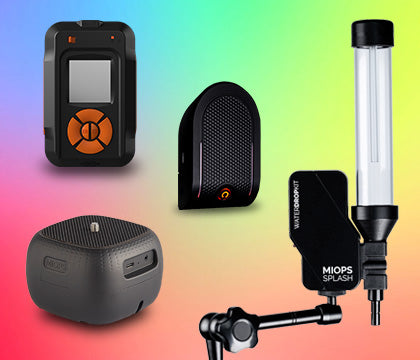
The MIOPS Smart+ does all of this in a single device, with sound, laser, and light detection modes and a delay dial that gives you control over exactly which millisecond you capture. For a closer look at the trigger mechanics and what each mode is suited for, see our guide on what is a high-speed camera trigger.
Setting Up Your First Shot Tonight
The best thing about high-speed flash photography is that you can prove the concept to yourself with what you already own, tonight, without buying anything new.
Find a room you can make properly dark. Bathrooms work well because they are small and the light sources are easy to control. Cover any LED standby indicators with tape. Slide a towel under the door. Take a test frame with your camera set to a two-second exposure and no flash. If the resulting image is completely black, you have done it correctly. If you can see anything at all, find the source and eliminate it. Ambient light bleed during a long exposure is the single most common reason first attempts at high-speed work come back soft and blurry rather than frozen and sharp.
Set up your camera on a tripod about a metre away from where the action will happen, with a 50mm to 85mm lens. Put your flash off to one side pointing at the subject area, set to 1/16 power or lower. Set camera to manual, ISO 100, f/11, shutter speed of two seconds.
The friendliest first subject is a water drop into a bowl placed below the camera. Point a dropper at the water surface, arm your trigger by sound, set a delay of about 12 milliseconds, and let a drop fall. The sound of the drop hitting the water fires the flash. At 12 milliseconds of delay you are catching the initial splash crown. Increase the delay to see the crown develop further. Decrease it to catch the very moment of impact. Once that is working, you have the complete method.
From that base, every other high-speed subject uses the same principles. A water-filled balloon popped with a pin uses sound triggering with a slightly shorter delay. Water drop collisions and crown shapes benefit from the MIOPS Splash system, which gives you consistent drop sizes and precise timing between drops so the collisions are repeatable rather than random. The subject changes; the setup does not.
Common Mistakes and Why They Happen
Soft images despite using a flash almost always mean ambient light. Find it and eliminate it. This is the number one issue we see, and the fix is thorough darkening of the room, not adjusting camera settings.
Missing the moment despite using a trigger usually means the delay is set wrong. If you are catching air where the subject should be, reduce the delay. If you are catching the aftermath, increase it. Work in small increments of one or two milliseconds and review each result.
Inconsistent results from shot to shot usually mean the action itself is inconsistent. A water drop falling from a pipette from a consistent height will hit the water at a consistent time. A drop squeezed from a bottle at varying heights will not. Standardize the action and the timing becomes predictable.
Underexposed results with correct settings usually mean the flash is not reaching the subject effectively, either due to distance or angle. Move the flash closer or adjust its angle before touching the aperture. Aperture is the last thing to change because it also affects depth of field, and you want as much of the subject in focus as possible.
Frequently Asked Questions
Do I really need an expensive camera for high-speed photography?
No, and we mean that seriously, not as a marketing caveat. In a dark room with flash providing the only light, your camera's shutter speed is not a limiting factor. A ten-year-old entry-level body will produce results identical to a current professional camera because neither is doing the actual freezing work. The flash is. Spend your budget on a decent speedlight and a trigger before you even consider a camera upgrade.
What if I cannot make my room fully dark?
Then the technique will not work as intended. Even faint ambient light, like a standby LED or light under a door, will create a second, motion-blurred exposure underneath the frozen flash exposure. The two layer onto each other and the result looks soft. Darken the room fully before troubleshooting anything else.
What exactly freezes the motion if the shutter speed is slow?
The flash pulse duration. At 1/16 power on a typical speedlight, the pulse lasts somewhere between 1/10,000 and 1/20,000 of a second. In a dark room that pulse is the only light reaching the sensor during your long exposure, so the effective capture time is the length of the pulse, not the length of the shutter opening. The subject is lit and recorded in that tiny window and then the room goes dark again.
How do I know what delay to set on the trigger?
Start at 10 to 15 milliseconds for most splash and burst subjects, which puts you in the early splash crown phase. If the frame is empty, reduce the delay. If you are catching the aftermath, increase it. There is no universal setting because subjects vary in how quickly they develop, so treat the delay dial as your creative control and adjust based on what you see.
Can I do high-speed photography with a speedlight I already own?
Almost certainly yes, as long as it has manual power adjustment and can be set to 1/16 power or lower. The pulse duration at lower power settings is short enough for most high-speed work. Professional studio strobes give you shorter pulses at lower power and more control, but a standard speedlight is a perfectly capable starting point.
Sources
MIOPS Smart+ product page: trigger specifications, sensitivity modes, and compatible camera list: https://www.miops.com/products/smart