



The Short Answer
There isn't one best lightning trigger for everyone, and any guide that says otherwise is selling rather than advising. Every current unit from a reputable maker detects a strike fast enough. What separates them is battery life, whether they work without a phone, how many other modes they offer, and whether they support your camera.
Decide which of those matter to how you shoot, and the choice makes itself. The best lightning trigger for photography in the field is rarely the one with the best headline specification. If you chase storms for hours, battery and standalone operation matter most. If you shoot occasionally from a porch, almost anything works.
What a Lightning Trigger Does
A lightning trigger watches for the flash of a strike and fires your camera automatically. It exists because a lightning flash is over faster than a person can react, with human reaction time running to roughly 200 to 300 milliseconds.
At night you can work around that with a long exposure, leaving the shutter open so a strike lands while the sensor is already recording. In daylight that approach collapses, because an exposure long enough to catch a random strike overexposes the sky. Daylight is where a trigger stops being a convenience.
Lightning Trigger or General Camera Trigger?
Worth settling first, because the two searches lead to different products. People looking for the best camera trigger usually want a multi-mode device that handles sound, laser, timelapse and HDR alongside lightning. People looking for the best camera lightning trigger want a unit built around storms specifically.
Both exist. A lightning-only device tends to be cheaper and simpler, with physical controls and nothing to learn beyond sensitivity. A multi-mode device costs more and earns that back only if you use the other modes.
Be honest with yourself about which you are. The most common regret in this category is buying breadth and never touching it, followed closely by buying narrow and wishing you had splash or timelapse capability a year later.
The Six Criteria That Matter Most
1. Detection Speed, and Why It's Mostly Settled
This is the specification everyone leads with, and it's the one that matters least when comparing current models.
Your camera has its own shutter lag, typically somewhere between 50 and 100 milliseconds from receiving the signal to actually opening the shutter. That delay is fifty to five hundred times larger than any difference between these triggers.
Pluto Trigger is upfront that its figure excludes camera shutter lag, and the same caveat applies to every brand. The practical conclusion is that once a trigger is under a few milliseconds, further speed claims are competing in a space your camera has already made irrelevant. Judge on the other five criteria.
2. Daylight Capability
A trigger that only works at night is half a trigger, because night lightning can be caught with bulb mode and patience. Check that sensitivity can be dialled down far enough to work against a bright sky without firing constantly on ambient light.
3. Adjustable Sensitivity
Conditions vary enormously between a distant night cell and a bright daytime storm overhead. A unit with a fixed or coarse sensitivity setting will either miss dim strikes or fill your card with frames triggered by nothing. Fine adjustment is worth more than raw speed.
4. Battery Life
This separates the field more than any spec sheet suggests, because storm work means long waits.
Published figures differ substantially. MIOPS lists four days for Smart+. The Pluto Trigger's product page lists about 20 hours in normal use, or around 40 with Bluetooth disabled, and several reviewers single out battery life as its weak point. Strike Finder 2 runs from a single 9 volt battery, which is easy to carry spares for but means buying disposables or keeping rechargeable 9 volts charged.
Neither approach is wrong. A removable 9 volt can be swapped in seconds in the field, while a built-in rechargeable means no consumables but a dead unit if you forgot to charge it. Match this to how you actually work.
5. Standalone or Phone Dependent
Some triggers are configured entirely through a phone app over Bluetooth. Others have a screen and buttons on the device and work without a phone at all.
This sounds minor until you're standing in wind and rain at night trying to unlock a phone with wet hands, or your phone battery is the thing that dies. A unit with on-device controls keeps working regardless. A phone-based unit is usually smaller and cheaper, and the app interface is often easier to learn.
6. Camera Support
A trigger connects through your camera's remote port, and connectors differ by manufacturer and sometimes by model within a brand. Confirm your exact body is supported before buying anything, and check whether the correct cable is included or sold separately, because practice varies between makers. Our camera compatibility guide covers how this works in detail.
Comparing the Main Options
Three devices come up most often when photographers research this category. The figures below are each manufacturer's published claims, not independent test results, and no one has run these head to head under controlled conditions as far as we know.
|
|
MIOPS Smart+ |
Strike Finder 2 |
Pluto Trigger (Discontinued) |
|---|---|---|---|
|
Maker |
MIOPS |
Ubertronix |
Baicheng Innovations |
|
Claimed detection |
1 ms |
As little as 1 ms |
0.2 ms |
|
Power |
Rechargeable, 4 days claimed |
Single 9 V battery |
Rechargeable, around 20 hrs claimed |
|
Works without a phone |
Yes, on-device screen |
Yes, on-device controls |
No, app required |
|
Other modes |
Sound, laser, timelapse, HDR, long exposure, bulb ramping |
Varies by model, Pro and Elite add sound and laser |
Unknown |
|
Cable included |
Yes, matched to your camera |
Sold separately on most listings |
Varies by listing |
Strike Finder Lightning Trigger
Ubertronix has been in this category a long time, and the Strike Finder line is squarely aimed at lightning rather than being a general purpose trigger with lightning included.
The current Strike Finder 2 is listed at as little as 1 millisecond response and runs from a 9 volt battery, with cables sold separately on most listings. Higher models in the range, the Pro II and the Elite, add sound and laser inputs, and the Elite adds motion detection. Compatibility is stated per model and some listings are older, so confirm the cable and camera pairing with the seller before ordering.
If you want a device built specifically around lightning, with physical controls and no app dependency, it's a credible choice.
Where Smart+ Fits
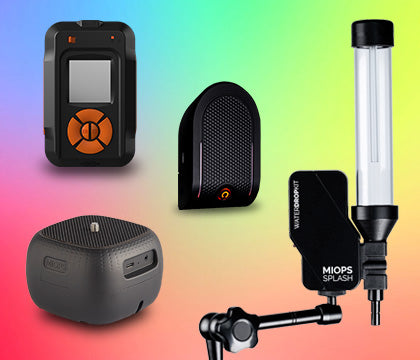
The MIOPS Smart+ detects a strike in 1 millisecond and covers lightning, sound, laser, timelapse, HDR, long exposure and bulb ramping in one unit. It works standalone through its own screen or through an app, supports over 600 camera models across 15 brands, and ships with the cable matched to your camera.
The honest case for it is breadth and field practicality rather than raw speed. It is not the fastest on paper, and if detection speed were the deciding factor the published numbers would point elsewhere. What it offers is a long battery, controls that work without a phone, and enough modes to stay useful outside storm season.
The wider case for it is what the other modes open up. The same unit that catches lightning fires on sound for balloon bursts and breaking glass, on a broken laser beam for splashes and wildlife, and on an interval for timelapse and star trails. Photographers weighing a Pluto Trigger alternative often find the deciding factor is not the storm work at all, but that one purchase covers several techniques they had assumed needed separate gear.
That matters most in the months when there are no storms. A lightning-only device sits in a drawer from autumn to spring. A multi-mode trigger gives you something to shoot in the meantime, which is how most people end up discovering water drop or high speed work.
Is a Lightning Trigger Worth It?
For daytime lightning, yes without qualification. There is no technique that substitutes for it, because the long exposure trick that works at night cannot work in daylight.
For night-only shooting, it's a genuine question. You can catch strikes with bulb mode, a tripod and patience, and plenty of good lightning photographs were taken that way before triggers were affordable. What a trigger buys you at night is a much higher keeper rate and individual frames you can choose between, instead of one long exposure containing whatever happened.
If you shoot one storm a year, patience is cheaper. If you chase storms deliberately, the trigger pays for itself in frames you would otherwise have missed.
Take almost impossible photos by turning your camera into a high-speed capture device! MIOPS Smart Trigger is a versatile camera...

Smart+ Multi-Mode Camera Trigger | Lightning, Sound, Laser and Timelapse
Lightning, sound, laser, timelapse and HDR in one trigger, with your camera cable included.
Test It Before the Storm Arrives
Whichever unit you buy, the first session should not be the first time you use it. Triggers need calibrating to conditions, and a storm is a poor classroom.
-
Test indoors with a camera flash. Fire a flash across the room with the trigger armed and confirm the camera responds. This proves the cable, the port and the mode are all working before weather is involved.
-
Learn the sensitivity range in advance. Find where it starts firing on ordinary room lighting and where it stops responding to a flash, so you know the useful band on your unit.
-
Switch the camera to manual focus. In autofocus the camera will try to focus before releasing, and in the dark it often fails and refuses to fire at all.
-
Disable auto power off. Many cameras will not wake from sleep on a signal from the remote port, and a storm that takes an hour to arrive can find the camera asleep.
Ten minutes of this at home prevents the most common field failure, which is a correctly connected setup that captures nothing and leaves you unsure which link in the chain broke.
Common Mistakes When Choosing
-
Buying on detection speed alone is the most common error, and the numbers involved are smaller than your camera's own shutter lag.
-
Ignoring battery life catches out people who shoot long sessions. A trigger that lasts twenty hours is not ideal because it can be limiting for a weekend of chasing.
-
Overlooking cable cost distorts comparisons. Some makers include the cable, others sell it separately, so compare the total rather than the headline price.
-
Skipping the compatibility check is the one that cannot be fixed afterwards. Confirm your exact camera model before ordering anything.
Frequently Asked Questions
What is the best lightning trigger?
There is no single best lightning trigger, because the right choice depends on how you shoot. Every current unit from a reputable maker detects strikes fast enough, so the deciding factors are battery life, whether it works without a phone, how many other modes you will use, and whether it supports your camera body.
What should I look for in a lightning trigger?
Six things: daylight capability, finely adjustable sensitivity, battery life long enough for your sessions, whether it works standalone or needs a phone, support for your exact camera model, and whether the cable is included. Detection speed matters least, since all current models are faster than your camera's shutter lag.
Is a lightning trigger worth it?
For daytime lightning, yes, because no technique substitutes for it. At night it is optional, since bulb mode and patience can catch strikes, though a trigger gives a much higher keeper rate and separate frames you can choose between. If you chase storms regularly it pays for itself.
How does Smart+ compare with other lightning triggers?
Smart+ detects in 1 millisecond, which is comparable to the Strike Finder 2 or slightly faster, though both sit far below camera shutter lag. Smart+ differentiates on a four day claimed battery, standalone operation without a phone, support for 600 plus cameras, and an included cable.
How fast does a lightning trigger need to be?
Fast enough to beat human reaction time, which runs to roughly 200 to 300 milliseconds. All current triggers clear that easily. Because camera shutter lag is typically 50 to 100 milliseconds, differences between triggers measured in fractions of a millisecond have no practical effect on what you capture.
Can I use a lightning trigger in daylight?
Yes, and this is the main reason to own one. Night lightning can be captured with a long exposure, but in daylight an exposure long enough to catch a random strike would overexpose the sky, so reacting to the flash is the only workable method.
Do lightning triggers work with any camera?
Only with cameras that have a wired remote shutter release port, and only with the correct cable for that model. Some entry level mirrorless bodies support Bluetooth remotes only and cannot be used with any wired trigger. Check your exact model on the maker's compatibility list before ordering.
Keep Exploring
Related reading: Lightning Trigger Camera Compatibility
Related reading: Choosing the Right Gear for Lightning Photography
Confirm your model is supported before you buy any trigger.
Sources
MIOPS Smart+ product page (1 ms detection, mode list, camera support, battery claim): https://www.miops.com/products/smart
B&H Photo listing, Ubertronix Strike Finder 2 (response time and 9 V battery): https://www.bhphotovideo.com/c/product/1371284-REG/ubertronix_3000_strike_finder_2_without.html