


You've set up the perfect shot. The light looks great. The plating is on point. You press the shutter, review the image, and think: that's the one.
Then you try to recreate it the next day. Different shadows. Different colors. Different mood. Same setup, completely different result.
That's the moment most food photographers hit a wall. Not because they need better food photography equipment, but because they haven't built a system that gives them control.
This guide will help you build one.
What Food Photography Equipment Actually Matters?
The short answer: your lens, your lighting, and your ability to repeat results. Your camera body matters least. A tripod, a single controlled light source, a softbox with grid, and a set of reflectors will take you further than any camera upgrade. For action shots like pours and splashes, a precision trigger like the MIOPS Smart+ closes the final gap. Everything else is secondary.
Your Camera Matters Less Than You Think
Here's the truth that most photographers don't want to hear: upgrading your camera body will not fix your food photography.
If you're shooting on a mid-range DSLR or mirrorless camera, you already have more than enough. The sensor is not your bottleneck. What actually moves the needle is the combination of three things:
-
Your lens
-
Your lighting setup
-
Your ability to repeat results
A fast prime lens like a 50mm f/1.8 or a 35mm f/1.8 will have a bigger impact on your images than any camera upgrade you could make. For tighter, more detailed shots where texture is everything, a macro lens in the 80 to 100mm range is where food photography really starts to come alive.
But even the sharpest lens in the world won't save you if your lighting is inconsistent. That's the real problem for most photographers.
Why Lighting Is the Real Bottleneck in Food Photography
Why are food photos inconsistent? Food photos are inconsistent because of three fixable problems: a light source that changes or cannot be rebuilt, no tripod locking the camera position between shots, and uncontrolled reflections from shiny surfaces. Solve those three and your results stabilise immediately.
Inconsistent lighting is the main reason food photos fail to replicate. Natural light shifts throughout the day and you cannot control it. A single strobe or speedlight paired with a softbox and grid gives you a repeatable, controlled source you can rebuild shot after shot, every time.
Most photographers know that lighting matters. The tricky part is knowing what to actually do about it.
Natural light is unreliable. Indoor ambient light is inconsistent. Cheap softboxes often produce weak or uneven output that creates more problems than it solves.
The result is a frustrating cycle: shoot, adjust, shoot again, still not right. And the culprit is almost never the light itself. It's the lack of control over it.
What You Actually Need
Three things make the real difference:
-
A strong, consistent light source (flash or strobe)
-
A modifier that shapes and controls the light (softbox with grid)
-
Tools to bounce and block light (reflectors and foam boards)
A Basic but Effective Food Photography Lighting Setup
Start here. This is all you need to get repeatable, professional results:
-
One speedlight or strobe
-
90cm softbox with grid
-
Light stand
-
5-in-1 reflector
-
Black and white foam boards
This combination gives you direction, softness, and contrast control. More importantly, it gives you repeatability. You can walk away, come back the next day, and rebuild the exact same light.
Food Photography Equipment That Quietly Makes the Biggest Difference
What food photography equipment do you actually need? You need a fast prime lens (50mm or 35mm f/1.8), one strobe or speedlight, a 90cm softbox with grid, a tripod, and a set of reflectors and foam boards. That combination covers the vast majority of food photography work. A color calibration card and circular polarizer are high-value additions. For action shots, add a MIOPS Smart+ trigger.
Some of the most impactful pieces of gear never make the highlight reels. Here's what actually changes your output:
Tripod
A tripod is not optional in food photography. Full stop.
Food photography is an iterative process. You shoot, adjust the plating, tweak the light, refine the composition, and repeat. Without a tripod locked in place, you lose consistency between every single frame. With one, you lock your composition and build precision into the whole workflow. Everything else becomes easier.
Reflectors and Foam Boards
Think of these as your real lighting tools, not accessories.
A white reflector fills shadows and lifts the mood. A black foam board adds contrast and drama. Moving either one by just a few centimetres can completely change the feeling of the image. If your lighting feels off, it is usually not the light source that is the problem. It is the way you are managing the bounce and the shadow.
Circular Polarizer
This one does not get nearly enough attention.
A circular polarizer cuts glare on shiny surfaces like glazes, sauces, glass, and cutlery. Instead of fighting reflections in post-production, you eliminate them on set. That is a cleaner image with less editing time.
Color Calibration Card
If your colors look different from shoot to shoot, this is why.
A simple gray card lets you nail white balance consistently. For anyone shooting commercial work for a brand or a client, this goes from useful to essential very quickly.
How to Build a Repeatable Food Photography Setup
A repeatable food photography setup comes down to locking three variables before you take a single shot: camera position, light position, and light control tools. Mount your camera on a tripod, place your key light at 45 degrees, and use foam boards to shape the shadows. Once those three are fixed, every iteration of the shot starts from the same baseline.
You do not need more gear. You need a system you can rebuild every time. Here is a workflow that delivers consistent results:
Step 1: Lock Your Composition
-
Mount your camera on a tripod
-
Frame your shot before you adjust anything else
-
Do not move the camera once you start shooting
Step 2: Set Your Light Position
-
Place your light at a 45-degree angle to the subject
-
Position it slightly above the food
-
Use a softbox with grid to prevent light spill
This setup creates natural depth and surface texture without flattening the subject.
Step 3: Shape the Shadows
-
Place a reflector opposite your key light to soften the shadows
-
Swap in a black board when you want more contrast and a moodier look
Small adjustments here produce big changes in the final image.
Step 4: Dial In Your Exposure
-
Shoot in manual mode
-
Keep ISO low for clean, noise-free images
-
Adjust your aperture to control depth of field
Step 5: Shoot and Refine
This is where the work actually happens. Take a shot, evaluate it, make a change, shoot again. It can feel slow at first, but with a controlled setup, every iteration is intentional. You are not chasing the shot. You are building it.
When Precision Tools Change Everything: MIOPS Smart+
Once your lighting is dialled in, the next bottleneck is timing. And timing is where most food photographers hit a wall.
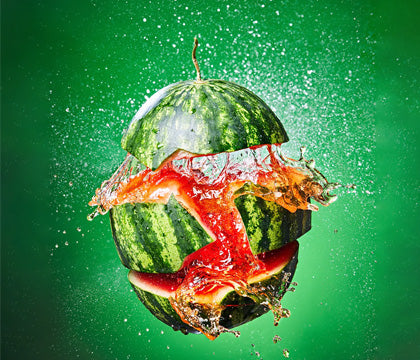
Pour shots, drips, splashes, and action-based food content are almost impossible to nail manually. You set everything up, pour the liquid, press the shutter at what feels like the right moment, and still miss it. Then you reset the whole scene and try again. The MIOPS Smart+ is what ends that cycle.
What Is the MIOPS Smart+?
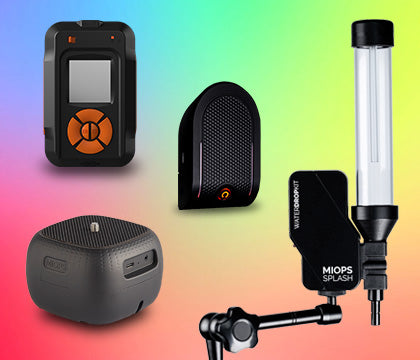
The MIOPS Smart+ is a camera and flash trigger built for high-speed photography. It connects to your camera via a dedicated cable, mounts to your hot shoe or tripod, and works with most DSLR and mirrorless cameras. Control it wirelessly through the MIOPS app on iOS or Android, or use it as a fully standalone device with no phone needed on set.
The three triggering modes that matter most for food photography:
-
Sound Mode: Fires the shutter the instant it detects a sound event. Perfect for capturing drips on impact and liquid splashes without guesswork.
-
Laser Mode: Triggers the camera the moment an object breaks a laser beam. Ideal for falling ingredients, pours, or anything moving through a defined path.
-
Timelapse Mode: Automates multi-shot sequences at set intervals, useful for cooking process and transformation sequences.
Why It Belongs in Your Setup
Without a trigger, action shots are a gamble. With the Smart+, they become a process you can repeat.
You stop hoping your reflexes caught the right frame and start defining exactly what event triggers the camera. The shot happens when the conditions are met. That is what moves you from burning through prep for one usable frame to building a repeatable system that delivers consistent results every time.
Common Mistakes That Keep Food Photographers Stuck
1. Buying gear without building a system
It is easy to get caught up collecting equipment piece by piece without understanding how it all works together. The result is an expensive, cluttered setup that still produces inconsistent results. Think in systems, not in individual tools.
2. Relying on natural light for consistent output
Natural light is beautiful for lifestyle shooting. It is a poor choice when repeatability matters. If you need to recreate a shot tomorrow, next week, or for a client, you need controlled light.
3. Using low-quality lighting that degrades over time
Cheap light sources often produce color shifts and uneven output as they age. That means inconsistent color across shoots and more time spent in post trying to compensate for it.
4. Underestimating light control tools
More light is rarely the answer. Better control of the light you already have almost always is. Reflectors and flags do more work than most photographers give them credit for.
5. Trying to wing timing-based shots
Pour shots, splash shots, and motion sequences require precision. Without a trigger system, you are guessing every single time. That is not a creative workflow. It is just luck.
A Practical Food Photography Setup You Can Actually Use
Here is a complete setup that covers 90 percent of food photography scenarios without unnecessary complexity:
Camera and lens
-
Any mid-range DSLR or mirrorless camera
-
50mm or 35mm prime lens
Lighting
-
One speedlight or strobe
-
90cm softbox with grid
Control tools
-
Tripod
-
5-in-1 reflector
-
Black and white foam boards
High-impact additions
-
Circular polarizer
-
Color calibration card
-
MIOPS Smart+ for action and timing-based shots
This is a setup built for control, repeatability, and results.
Quick Summary: Food Photography Equipment That Actually Matters
|
What |
Why It Matters |
|
Fast prime lens (50mm or 35mm f/1.8) |
More impact than any camera upgrade |
|
Macro lens (80 to 100mm) |
Close-up texture and sharpness control |
|
Strobe or speedlight + 90cm softbox with grid |
Consistent, repeatable light you can rebuild |
|
Tripod |
Locks composition across every iteration |
|
Reflectors and foam boards |
Controls shadows and contrast without adding more light |
|
Circular polarizer |
Eliminates glare on sauces, glass, and cutlery on set |
|
Color calibration card |
Keeps white balance consistent across shoots |
|
MIOPS Smart+ |
Automates timing for pours, splashes, and action shots |
The camera body is not on this list for a reason.
SEE WHAT THE MIOPS SMART+ CAN DOSound, laser, lightning, timelapse, HDR, and bulb ramping. One device. Compatible with Sony, Canon, Nikon, Fujifilm, and more. |
Frequently Asked Questions
What is the best camera for food photography?
Any mid-range DSLR or mirrorless camera is more than capable. Lens quality and lighting control have a far greater impact on your results than the camera body. Stop looking at camera upgrades and start looking at your light.
What lens is best for food photography?
A 50mm or 35mm prime lens covers most food photography setups well. For close-up detail shots where texture and sharpness really matter, a macro lens in the 80 to 100mm range gives you significantly more control.
Do I need artificial lighting for food photography?
If consistent results are the goal, yes. Natural light is unpredictable and changes throughout the day. A single strobe or speedlight with a softbox gives you a controlled, repeatable light source you can rebuild every session.
Why are my food photos inconsistent?
The most common culprits are inconsistent lighting, not locking your camera on a tripod, and uncontrolled reflections. Fix those three variables and your results will stabilise immediately.
How do I capture motion or splash shots in food photography?
Manual timing rarely works for these shots. A camera trigger like the MIOPS Smart+ lets you automate the moment using sound or laser triggering modes, so the camera fires at the exact instant the action happens, every time.